Project Summary
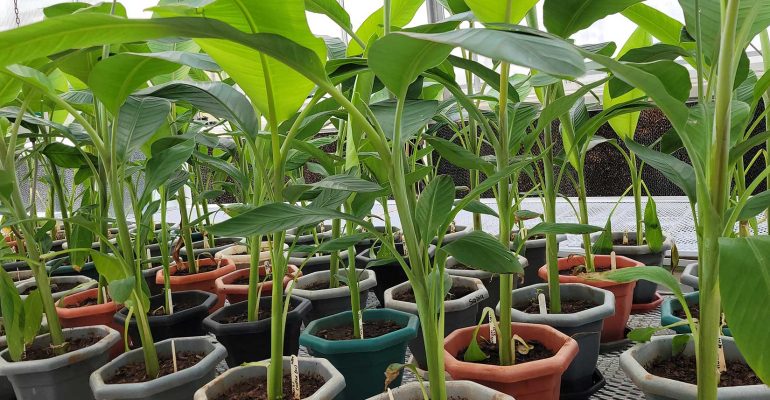
The East African Highland Banana (EAHB), or Matooke, is an important staple crop for smallholder farmers in East Africa, providing essential food and income. However, its production is severely threatened by diseases, particularly Banana Xanthomonas wilt (BXW), caused by Xanthomonas vasicola pv. musacearum (Xvm). The primary goal of this project is to enhance banana production by reducing losses from BXW disease while empowering local stakeholders with the skills and tools needed for banana improvement using modern biotechnological tools such as transgenic methods and genome-editing. The expected outcome of this project is BXW-resistant cultivars that will significantly benefit smallholder farmers, particularly women, who dominate banana marketing in the region.
Aim
Enhance smallholder banana production by mitigating losses caused by Banana Xanthomonas wilt (BXW) disease, while strengthening the capabilities of local partners to utilize modern biotechnological tools for banana improvement.
Objectives
- To develop transgenic banana cultivars resistant to BXW for Kenya, Uganda, and Rwanda.
- To generate second-generation BXW-resistant banana varieties through gene editing.
- To strengthen the capacity of local and national researchers and regulators in gene editing technologies.
- To offer communication support to the product developing partners.
- To develop regulatory and stewardship strategies for the release of improved banana varieties.
Outcomes
- Availability of BXW resistant transgenic banana cultivars for farmers in East Africa.
- Release of BXW–resistant gene-edited banana in East Africa. .
- Enhanced capacity for the development and commercialization of gene-edited products in Africa.
Partners
- UMD
- NARO
- KALRO
Target Country
- Kenya
- Rwanda
- Uganda
Research Location
- Kenya: Nairobi
- Uganda: Kawanda, Kampala
- USA: Maryland