The International Institute of Tropical Agriculture (IITA) is pleased to announce its partnership with the University of California, Davis (UC Davis), the Innovative Genomics Institute (IGI) at UC Berkeley, and the African Orphan Crops Consortium (AOCC), to introduce a new course on gene editing as part of the African Plant Breeding Academy (AfPBA). The course will empower 80-100 African scientists to apply the CRISPR-based gene-editing technologies to improve food crops important for African nutritional security for the essential traits.
CRISPR holds enormous promise for making precise desired genetic changes, enabling plant breeders to rise to the challenges of a changing climate and rapidly growing population at the demanded pace.
About the AfPBA CRISPR course
The AfPBA CRISPR course aims to train African scientists engaged in crop improvement, particularly those working in national research institutions desiring to implement or initiate gene-editing programs.
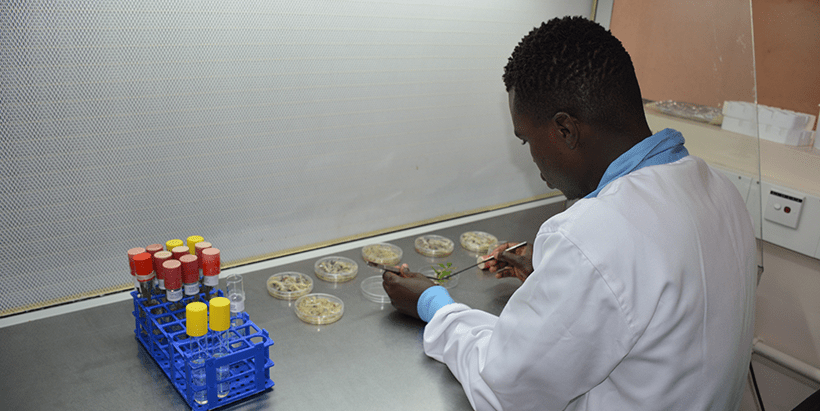
The course is an intensive 6-week program, delivered in three 2-week sessions at IITA hosted by B4A/ILRI hub and World Agroforestry in Nairobi, Kenya, over a period of a year and can accommodate 20 participants per course offering. It focuses on the steps to accomplish gene editing from design through validation. Using banana as a model plant, participants formulate objectives and targets, design plasmids, perform trait delivery to cells, regenerate plants, and validate results. The course prepares participants to develop key traits (e.g., nutritional content, disease resistance, longer shelf life) in crops aligned with their national and institutional priorities.
Uniqueness of AfPBA CRISPR course
This program involves post-course mentorship and ongoing support for sustained lab productivity beyond course completion and the founding of translational partnerships for commercialization and value chain development.
The course leverages genome sequence information being amassed by the AOCC on 101 African orphan crops, including a diversity of vegetables, fruits, nuts, legumes, oilseeds, cereals, and tree species. Furthermore, it emphasizes the role of CRISPR in the overall scheme of improved cultivar development and in addressing the needs of smallholder farmers. It will support a Community of Practice strongly linked to the disciplines required for product development and launch, improved variety distribution, and farmer adoption.